

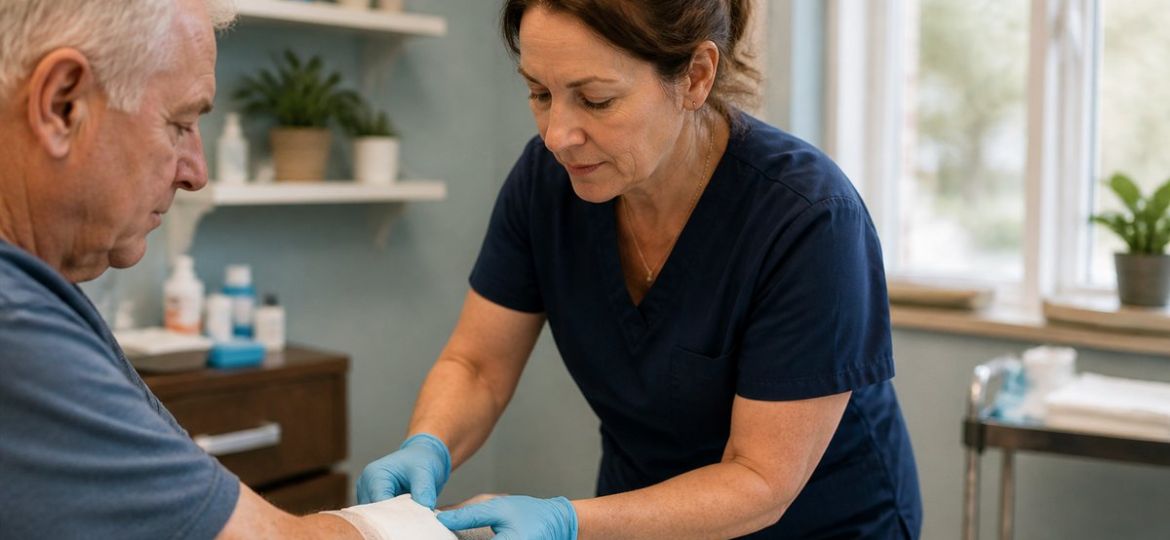
Chronic and complex wounds place steady demands on the body, and they often need structured support to progress through healing. Advanced wound care focuses on removing damaged tissue, protecting healthy structures, and managing moisture and pressure so the wound environment stays stable. When treatment is tailored to the wound’s cause and depth, healing has a better chance of moving forward instead of stalling.
Surgical or Ultrasound Debridement
When dead tissue sits in a wound, healing slows, and the risk of infection rises. Surgical or ultrasound debridement removes this nonviable tissue, and it exposes healthier structures that respond better to dressings and therapies. A wound care specialist evaluates the wound depth and location before choosing the method, and they match the technique to the patient’s overall health.
Surgical debridement uses instruments to cut away dead tissue, while ultrasound debridement relies on targeted sound waves and irrigation. Both methods aim to create a clean wound bed. They support the next stage of treatment, which might involve dressings, pressure relief, or advanced therapies.
Total Contact Casting
Total contact casting is used for certain foot ulcers, and it works by spreading weight evenly along the leg and foot. The cast limits motion at the wound site, and it reduces high-pressure points that break down tissue. Since the cast stays in place for a set period, it also protects the wound from friction and unplanned trauma.
- The cast distributes pressure across the entire plantar surface.
- The cast restricts ankle and foot motion around the wound.
- The rigid outer shell shields the area from bumps and shear.
Negative Pressure Wound Therapy
Negative pressure wound therapy uses a sealed dressing and a controlled vacuum to manage fluid and support tissue. After the wound is cleaned and prepared, a foam or gauze interface is placed inside the wound, and tubing connects the dressing to a pump. The system removes exudate while the negative pressure draws wound edges together and stabilizes the environment.
This therapy helps manage complex wounds with heavy drainage, and it often reduces the number of dressing changes. When fluid is removed efficiently, the surrounding skin stays more intact, and it minimizes the risk of maceration. The therapy can be used between surgical procedures, and it sometimes prepares a wound bed for grafting or closure.
Settings for negative pressure wound therapy are selected based on wound size, depth, and tissue type. Clinicians monitor the wound for granulation tissue, and they adjust the regimen if progress slows. With consistent use and regular assessment, this therapy supports broader wound care plans that address circulation, nutrition, and infection control.
Cellular Treatments
Cellular treatments use grafting materials that supply a scaffold or living cells to support repair. These products are placed on a well-prepared wound bed, and they integrate with the tissue over time. Some grafts are derived from human or animal tissue, and others are engineered matrices without living cells. When paired with pressure relief, moisture balance, and infection management, cellular treatments serve as a bridge between chronic nonhealing tissue and more stable, durable coverage.
Get Complex Wound Care
Complex wounds benefit from a structured plan that layers therapies based on wound depth, blood flow, and infection risk. A specialized team reviews imaging and wound measurements, and they select options like debridement or grafting as the wound evolves. If a wound stops improving or repeatedly reopens, advanced wound care services offer structured strategies that address both the wound surface and the underlying causes.
